The Role of Fascia in Mobility: What You Need to Know
Fascia is defined as a continuous connective tissue network that wraps around every muscle, bone, organ, and nerve in your body. The role of fascia in mobility goes far beyond simple structural support. Fascia is densely packed with mechanoreceptors and nerve endings, making it one of the body’s richest sensory organs. When fascia glides freely, movement feels fluid and coordinated. When it stiffens or densifies, range of motion drops, pain increases, and athletic performance suffers. Understanding how fascia works gives you a direct path to fixing mobility problems that standard muscle stretching alone cannot solve.
How does fascia anatomy support mobility and proprioception?
Fascia is built from layered collagen fibers arranged in multiple directions. That structure gives it both tensile strength and the elasticity needed to stretch, recoil, and transmit force across the body. Unlike tendons, which run in a single direction, fascial sheets spread force broadly, connecting distant body regions into one continuous mechanical system.
The sensory role of fascia is what separates it from other connective tissues. Ruffini and Pacini corpuscles, along with free nerve endings, populate fascia at high density. These receptors detect pressure, stretch, and vibration, then feed that information directly into the nervous system. The result is proprioceptive feedback: your brain’s real-time map of where your body is in space and how it is moving.

Fascia also stores and releases elastic energy during movement, functioning more like a spring than a passive wrapping. This energy storage capacity reduces the metabolic cost of repetitive movements like running or jumping. Athletes who maintain healthy fascial tissue get more output from the same muscular effort.
The body operates on what researchers call a tensegrity model. In this model, fascia transmits tension globally, meaning a restriction in your calf can alter load distribution at your hip or lower back. No body part moves in isolation. Fascia is the tissue that makes the whole system talk to itself.
Pro Tip: Slow, controlled movements like yoga or tai chi activate fascial mechanoreceptors more effectively than fast, repetitive exercise. Adding at least one slow movement session per week directly trains your fascial sensory system.
What happens to fascia when movement decreases?
Fascial densification is the process by which fascial layers lose their ability to slide past one another. It occurs with immobility, repetitive low-variety motion, and chronic postural stress. Reduced fascial glide causes stiffness and functional movement impairment even when muscles and bones appear completely normal on imaging. That finding explains why many people with persistent pain get clear MRI results yet still cannot move freely.
Clinical data makes the consequences concrete. People with chronic low back pain show a 20% reduction in shear strain between fascial layers, directly correlated with reduced trunk flexion and extension range. A 20% drop in fascial glide is enough to measurably restrict how far you can bend, rotate, or reach.
Immobilization accelerates the problem. MRI studies show fascial deterioration after as little as three weeks of immobilization, with visible disorganization and densification of the extracellular matrix. That deterioration contributes directly to post-injury stiffness and the prolonged recovery times athletes and physical therapy patients experience after periods of reduced activity.
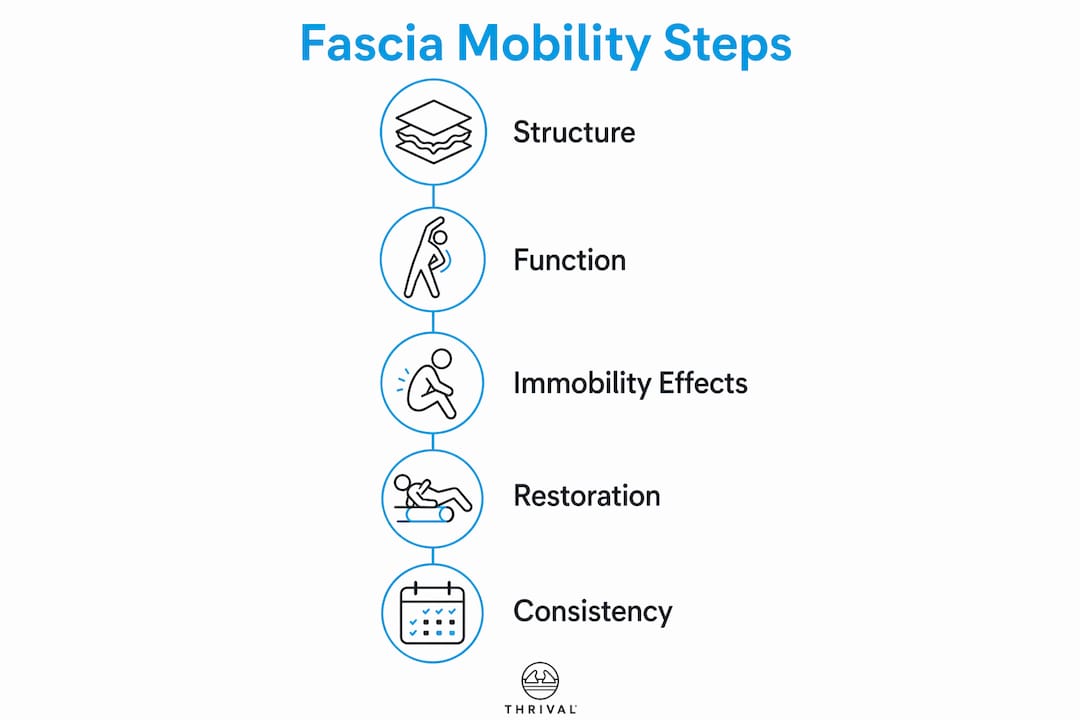
Fascia also tethers nerves. When fascial layers become sticky and restricted, they can compress or tether nearby nerve fibers, generating referred and neuropathic-like pain that does not follow standard nerve distribution patterns. This mechanism explains many complex, hard-to-diagnose pain presentations that do not respond to conventional treatment.
| Condition | Fascial effect | Movement consequence |
|---|---|---|
| Chronic low back pain | 20% reduction in shear strain | Reduced trunk flexion and extension |
| Three weeks of immobilization | Extracellular matrix disorganization | Stiffness, pain, slow recovery |
| Repetitive low-variety motion | Layer densification | Restricted glide, reduced range of motion |
| Chronic stress | Fascial inflammation and stiffening | Impaired movement and autonomic dysregulation |
Pro Tip: If you sit for more than two hours at a stretch, your thoracolumbar fascia begins to lose hydration and glide. Set a timer to stand and move through a full range of motion every 90 minutes.
How does fascial dysfunction affect athletic and everyday movement?
Fascial restrictions reduce movement efficiency by disrupting force transmission across the tensegrity network. When one region stiffens, tension imbalances create inefficient movement patterns and shift load onto joints and muscles that were not designed to carry it. A runner with restricted plantar fascia, for example, will compensate through altered hip mechanics, which over time creates knee or lower back pain far from the original restriction.
Decreased proprioceptive input from stiff fascia also impairs motor control. The brain receives less accurate sensory data about limb position and tissue tension, so it produces less coordinated movement. Fascia plays a critical role in anticipatory motor control, meaning the nervous system uses fascial feedback to pre-program muscle activation before movement even begins. Stiffen the fascia, and that pre-programming degrades.
Common movement patterns affected by fascial dysfunction include:
- Hip flexion and extension: Restricted iliopsoas fascia limits stride length and increases lumbar compression during walking and running.
- Shoulder rotation: Densified pectoral and thoracic fascia reduces overhead reach and internal rotation, a common issue for swimmers and throwers.
- Spinal rotation: Thoracolumbar fascial stiffness directly limits rotational power in sports like golf, tennis, and baseball.
- Squat depth: Restricted ankle and calf fascia forces compensatory forward lean, increasing knee and lower back stress.
Chronic stress compounds the problem. Stress-induced fascial stiffness links emotional states to physical mobility, meaning an athlete under high psychological load may experience genuine fascial tension increases that impair performance independent of training load. This mind-body connection is not theoretical. It shows up in tissue mechanics.
What are the most effective strategies to restore fascial mobility?
Varied, multidirectional movement is the most evidence-supported approach to maintaining fascial health. Gentle, consistent movement improves fascial glide more effectively than high-force interventions. The collagen fibers in fascia remodel along lines of mechanical stress, so exposing them to multiple movement directions promotes organized, functional fiber alignment rather than the disorganized densification seen with repetitive or absent movement.
Hydration directly affects fascial tissue glide. Fascia contains a gel-like ground substance that lubricates the sliding surfaces between layers. Dehydration reduces this lubrication, increasing friction between fascial planes and accelerating densification. Adequate daily water intake is a non-negotiable baseline for fascial health, not a secondary consideration.
Myofascial release is the most studied therapeutic intervention for restoring fascial mobility. Sustained fascial stretch triggers a parasympathetic response and neuromodulation that reduces muscle tone and pain. This is why slow, sustained pressure outperforms rapid, aggressive techniques for lasting results. Physical therapists use manual therapy techniques targeting specific fascial layers to restore glide and reduce pain in clinical settings.
Practical strategies ranked by evidence and accessibility:
- Multidirectional daily movement: Walk, rotate, reach, and bend in multiple planes every day. Avoid repeating the same movement pattern for hours without variation.
- Sustained static stretching: Hold stretches for 90 seconds or longer to engage the viscoelastic properties of fascial tissue, not just muscle length.
- Self-myofascial release with targeted tools: Apply sustained, moderate pressure to restricted areas using a deep tissue tool. Slow, deliberate pressure activates the neurological pathways that reduce fascial tone.
- Hydration: Drink enough water to keep urine pale yellow throughout the day. Fascial tissue responds to hydration status within hours.
- Progressive loading: Gradually increase training load and movement variety to stimulate healthy collagen remodeling without overloading fascial structures.
| Approach | Mechanism | Best use case |
|---|---|---|
| Multidirectional movement | Promotes collagen alignment and glide | Daily maintenance for all activity levels |
| Sustained stretching (90+ seconds) | Engages viscoelastic tissue response | Post-workout or morning mobility sessions |
| Self-myofascial release tools | Neuromodulation and mechanical glide restoration | Targeted relief for specific tight spots |
| Manual therapy | Layer-specific fascial mobilization | Clinical treatment of chronic restrictions |
You can also assess your baseline joint mobility to identify which regions need the most fascial attention before building a targeted routine.
Key Takeaways
Fascia is an active sensory and mechanical tissue whose health directly determines the quality, range, and efficiency of every movement you make.
| Point | Details |
|---|---|
| Fascia controls glide and range | A 20% reduction in fascial shear strain measurably restricts trunk flexion and extension. |
| Immobility damages fascia fast | MRI shows fascial disorganization after just three weeks of immobilization. |
| Tensegrity links the whole body | A restriction in one region shifts load and alters movement patterns at distant sites. |
| Sustained pressure beats aggressive force | Slow myofascial release triggers neuromodulation and parasympathetic response for lasting relief. |
| Hydration and movement variety are foundational | Daily multidirectional movement and adequate water intake maintain fascial glide without any tools. |
Fascia care is not about intensity. It’s about consistency.
Most people who struggle with persistent stiffness are not dealing with a muscle problem. They are dealing with a fascia problem that nobody has named correctly. I have seen this pattern repeatedly: athletes who stretch daily, train hard, and still cannot get full hip flexion or shoulder rotation. The missing piece is almost always fascial glide, not muscle length.
The biggest misconception I encounter is that more pressure equals better results. Aggressive deep-tissue work feels productive, but it often triggers a protective guarding response in the nervous system. The research backs this up. Sustained, moderate pressure activates the parasympathetic nervous system and produces genuine neuromodulation. Grinding into a tight spot with maximum force does the opposite.
What actually works is boring but effective: move in multiple directions every day, hold stretches long enough to engage the viscoelastic tissue response, stay hydrated, and apply targeted pressure with a quality tool consistently. The athletes I have seen make the most progress with fascial mobility are not the ones doing the most aggressive work. They are the ones doing the right work every single day without skipping it.
Fascia also responds to stress in ways that most training programs completely ignore. If you are under high psychological load and your mobility is declining despite consistent training, your fascial tissue may be stiffening in response to autonomic nervous system activation. Addressing sleep, recovery, and stress management is not soft advice. It is tissue-level physiology.
Start with muscle mobility fundamentals and build from there. Fascia care works best when it is integrated into a broader movement practice, not treated as a separate add-on.
— Cameron
Fascia responds to targeted, sustained pressure applied consistently to the right spots. Thrival’s deep tissue recovery system is built around exactly that principle.

The Thrival Deep Tissue Pro uses a modular base board with interchangeable attachments, including the Wave, Bullseye, Arch, and Ballhead, each designed to reach specific muscle groups and fascial layers in the back, hips, neck, and shoulders. The system is non-motorized, which means you control the pressure and duration. That control is what makes sustained, neurologically effective fascial release possible. Thrival tools are FDA-registered, US-manufactured, and backed by a lifetime warranty. Explore the full system at Thrival.com and find the attachment that fits your tightest spots.
FAQ
What is the role of fascia in mobility?
Fascia is a continuous connective tissue network that enables muscles and joints to glide, transmit force, and receive proprioceptive feedback. When fascia loses its ability to glide freely, range of motion decreases and pain increases even when muscles and bones appear structurally normal.
How does fascial stiffness cause pain?
Fascial restrictions tether nearby nerve fibers and disrupt force transmission, generating referred and neuropathic-like pain that does not follow standard nerve distribution patterns. This mechanism explains many complex pain presentations that do not respond to conventional muscle-focused treatment.
What are the best fascia mobility exercises?
Multidirectional movement, sustained static stretching held for 90 seconds or longer, and self-myofascial release with targeted pressure tools are the most evidence-supported approaches. Varied movement promotes collagen alignment, while sustained pressure activates neurological pathways that reduce fascial tone.
Can fascia affect athletic performance?
Fascial restrictions reduce force transmission efficiency and impair proprioceptive feedback, degrading motor control and movement coordination. A restriction in one area, such as the plantar fascia, can alter hip mechanics and create pain at distant sites like the knee or lower back.
How quickly does fascia deteriorate with immobility?
MRI studies show visible fascial disorganization and densification after as little as three weeks of immobilization. That deterioration contributes directly to the stiffness and prolonged recovery times seen after injury or periods of reduced activity.
Recommended
source http://www.expertclick.com/NewsRelease/The-Role-of-Fascia-in-Mobility-What-You-Need-to-Know,2026315779.aspx


Comments
Post a Comment