Fit Volatility: Pumping Iron Edition
How do trends related to muscle building and loss contribute to Fit Volatility?
I’ll give you three instances.
1 – Men Want Stronger Butts.
A fresh WSJ article discusses where guys are now focusing their strength training efforts.
The trend isn’t barrel chests and peaks on the biceps. Rather, it’s large quads and stronger glutes.
As someone who has spent the better part of 25+ years inside the four walls of a gym, I could tell you the benefits of never skipping your squats, leg presses and deadlifts. Glute activation is a mandatory pre-requisite to generate power for these compound lifts.
But now male business elites perceive strong legs and an upper back as a sign of longevity and health. Male actors see a chiseled rear end as a necessary line item on the acting resume.
2 – More Women Leaders Lift Weights
Women’s health is re-writing its narrative after decades of operating under the assumption that women are just smaller versions of men.
Resistance training for women is powerfully beneficial, especially for those in the perimenopausal cohort and those holding leadership positions.
Also, US gym participation data shows strength training is the most popular workout among both genders, with 52% of female participants and 65% of male; a meaningful closing of a gap that was much wider a decade ago.
Cardio equipment now takes up less square footage in gyms, getting swapped out for squat racks and benches (Gold’s Gym has dropped cardio equipment by 15%, for instance) to accommodate the growing interest from women.
Moreover, the sculpted physique isn’t only a weapon against aging. It’s also becoming a status symbol that signals commitment, discipline and success.
3 – GLP-1’s Without Weights Leave You Flat
At the same time, another WSJ article discusses the potential of a frailty epidemic related to GLP-1 use.
Reason being, patients on GLP-1’s lose lean muscle mass as they proceed through their weight loss journey.
But the outcome isn’t a direct result of the drug. It’s a secondary factor: when someone is in a calorie deficit without sufficient strength training, some of the weight lost will be lean muscle.
Athletes and bodybuilders are keenly aware of this, but the general population needs the same knowledge. Younger people on GLP-1’s can be more resilient to muscle loss. Those who are 55+ may have a harder time.
The other part of the equation is discontinuation. Patients can rapidly regain 60% to 70% of the weight lost, but the regain doesn’t follow the same pattern as the loss. Without a proper strength training program, the regained weight shows up as fat.
Basically, there is a complete reconfiguration of body composition.
Muscular Fit Volatility
The impacts of pumping iron across genders and demographics will all contribute to Fit Volatility.
The immediate implication you might think of is with performance and athleisure brands. But the implications are far broader, because Fit Volatility is a dynamic convergence of multiple factors at once, made more complicated by GLP-1 usage.
The systems the apparel business uses to create product are far too static to keep pace.
Fit Volatility is a unique combination of social, financial, tech, geographical, innovation, health, and unprecedented event factors. And of course, these don’t occur in isolation from one another.
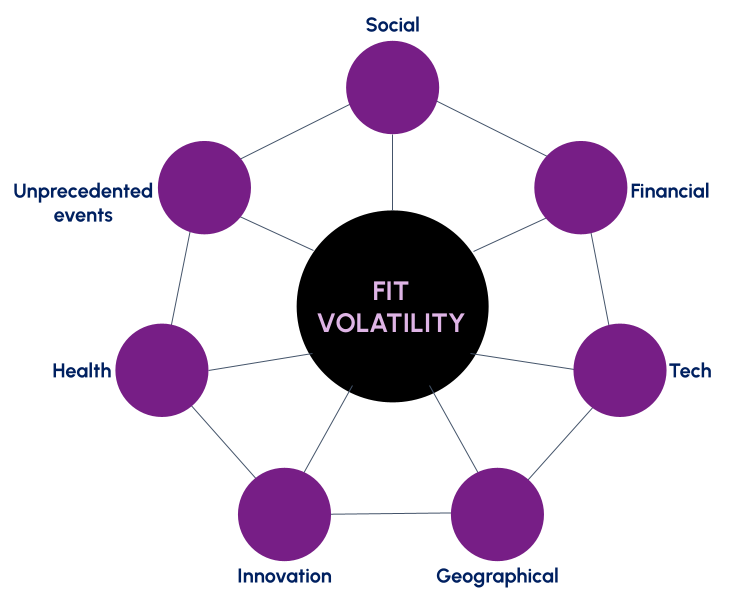
For instance, the male who wants to grow his lower body may be doing so because he recently got a promotion and wants to project a particular image. That promotion also means moving to a warmer climate. How does his apparel need to evolve now?
These changes in body composition will impact all forms of casual wear, formal wear, PPE and related garments, professional uniforms, uniforms for the armed forces, and maternity wear.
We can’t just expect to use stretch and performance fabrics as the sole, universal ointment to accommodate body changes related to muscle growth and loss.
And with a shortage of skilled sewing labor, we may also run into a scenario where we can’t tailor our way through Fit Volatility.
About Retail Strategy Group
Founded in 2020, Retail Strategy Group works with market-leading brands to help them improve profitability and increase organizational effectiveness. The firm produces a weekly newsletter, The Merchant Life, where retail executives find the best retail insights and new, provocative ideas. For more information, visit www.retailstrategygroup.com.
source http://www.expertclick.com/NewsRelease/Fit-Volatility-Pumping-Iron-Edition,2026314812.aspx


Comments
Post a Comment