5 Evidence-Based Benefits of Soft Tissue Release
Most athletes know the drill: stretch before you train, stretch after, repeat. But stretching alone doesn’t address the real obstacles to muscle recovery, including restricted fascia, dense adhesions in muscle tissue, and lingering inflammation that stretching simply can’t reach. Soft tissue release (STR) is a targeted intervention that goes deeper, literally and mechanically, than passive flexibility work. Research consistently shows it improves joint range of motion, reduces post-exercise soreness, and supports faster return to activity. This guide breaks down five science-backed benefits of STR and shows you how to put each one to work.
Table of Contents
Key Takeaways
| Point | Details |
|---|---|
| STR Improves Mobility | Soft tissue release significantly increases joint flexibility and range of motion in athletes. |
| Speeds Muscle Recovery | STR reduces soreness, pain, and inflammation for faster, more comfortable recovery post-exercise. |
| Best With Rehab | Combining STR with active exercise gives better results than either approach alone. |
| Watch for Overuse | Aggressive or excessive STR can cause problems—listen to your body and use proper technique. |
| Performance Gains Vary | STR consistently helps with mobility and pain but isn’t a guaranteed shortcut for speed or strength. |
What is soft tissue release? Understanding the basics
Soft tissue release is a hands-on or tool-assisted method of applying sustained, directional pressure to muscles, tendons, and connective tissue called fascia. It is different from static stretching, which simply lengthens a muscle by holding a fixed position. It is also distinct from general massage, which tends to work broadly across surface tissue. STR targets specific layers of tissue and uses controlled pressure to release restrictions at the source.
Key STR techniques include:
- Self-myofascial release (SMR): Using a foam roller, massage ball, or recovery tool to apply sustained pressure to tight spots. This is the most accessible form of STR and is well-supported for improving flexibility and reducing soreness.
- Instrument-assisted soft tissue mobilization (IASTM): A clinician or practitioner uses a rigid tool to scrape along the skin surface, targeting underlying fascial adhesions with precision.
- Active release technique (ART): A provider applies pressure to a specific point while guiding the limb through a range of motion, creating a moving stretch through the target tissue.
- Myofascial release: Sustained, low-load pressure held over several minutes to encourage the fascia to release and rehydrate.
The science behind massage benefits confirms that pressure-based interventions affect both the nervous system and the mechanical structure of tissue. STR techniques, including SMR, IASTM, ART, and myofascial release, improve joint range of motion in athletes and active individuals across a variety of settings and sports. For those dealing with painful knots or chronic tightness, trigger point therapy works alongside STR to deliver localized relief.
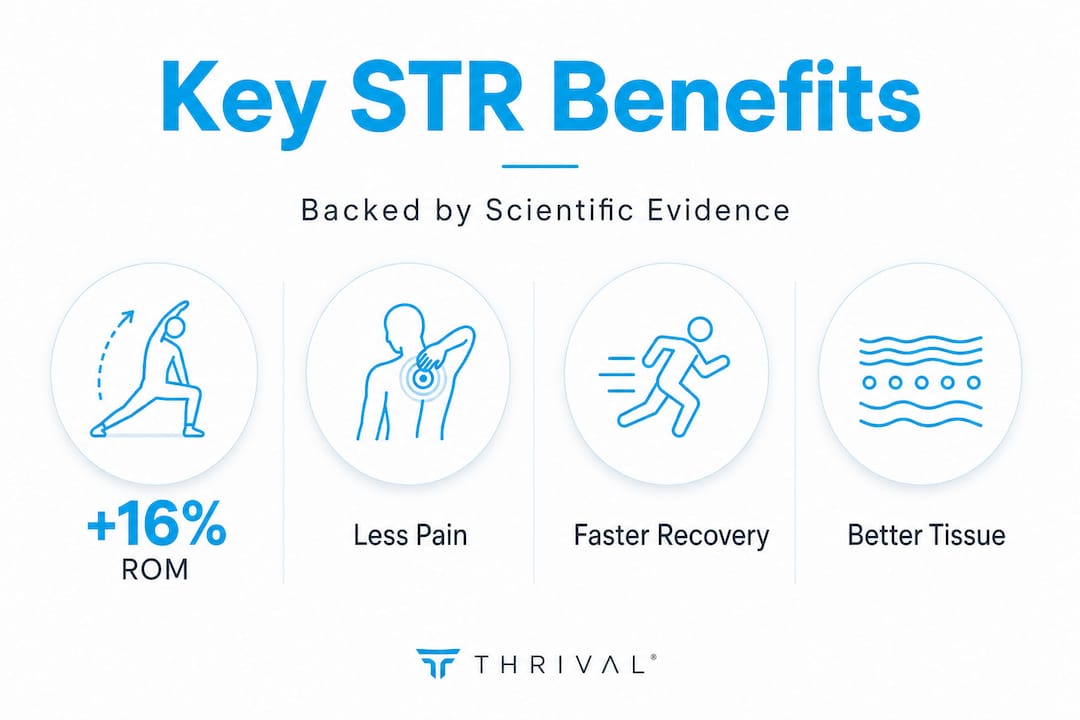
“Studies show STR can improve joint range of motion by up to 16.4% after just 5 minutes of foam rolling.”
That kind of improvement from a brief session makes STR one of the most time-efficient recovery tools available.
Top 5 science-backed benefits of soft tissue release
Understanding the primary features of STR, let’s dive into the leading, research-backed benefits you can expect from this technique.
Benefit 1: Increased joint range of motion and flexibility
Improved range of motion (ROM) is the most consistently documented benefit of STR across multiple research populations. Athletes who foam roll regularly show measurable increases in hip flexor mobility, ankle dorsiflexion, and hamstring length. Understanding why mobility matters goes beyond performance aesthetics; restricted joints increase injury risk and limit athletic output over time.

Benefit 2: Reduced pain and post-exercise muscle soreness (DOMS)
Delayed onset muscle soreness (DOMS) peaks between 24 and 72 hours after intense exercise. STR reduces pain, DOMS, and inflammation markers like interleukin-6 (IL-6) and creatine kinase (CK), which are direct indicators of muscle tissue stress. Athletes who use foam rolling or SMR tools after training report significantly lower pain scores in the days following exercise compared to those who rest passively.
Benefit 3: Decreased inflammation markers for faster recovery
The reduction in circulating IL-6 and CK after STR sessions is not trivial. These biomarkers signal how much cellular damage is present in muscle tissue. Lower levels after STR suggest the body is clearing damage products more efficiently, which translates directly to fewer missed training days and better week-to-week consistency.
Benefit 4: Enhanced tissue quality
IASTM and functional IASTM improve hamstring flexibility comparably to static stretching, and they reduce skinfold thickness more effectively in sedentary adults, suggesting real structural changes at the tissue level. Better tissue quality means muscles slide against each other with less friction, producing cleaner movement patterns and reducing the likelihood of compensatory injuries.
Benefit 5: Safer return to activity
For athletes recovering from overuse injuries or muscle strains, STR offers a controlled way to reintroduce load to healing tissue. When used alongside active rehabilitation, it helps maintain tissue mobility and prevents scar tissue buildup during the recovery window.
16.4% improvement in lunge scores after just 5 minutes of foam rolling. This single stat reframes how you should think about pre-session warm-up protocols.
| Benefit | Supporting evidence | Key technique |
|---|---|---|
| Increased ROM and flexibility | Up to 16.4% improvement in functional movement | Foam rolling (SMR) |
| Reduced DOMS and pain | Lower IL-6 and CK post-exercise | SMR, ART |
| Decreased inflammation | Faster biomarker clearance after training | Myofascial release |
| Improved tissue quality | Reduced skinfold thickness, better muscle slide | IASTM, functional IASTM |
| Safer return to activity | Maintained tissue mobility during rehab | ART, gentle SMR |
Exploring the right muscle recovery tools helps you match the technique to your specific training demands and recovery goals.
When, why, and how to use soft tissue release
Now that you know what STR offers, here’s how to fit it effectively into your workout or recovery routine.
Timing matters more than most athletes realize. A short SMR session of one to two minutes per muscle group before training can enhance ROM and prepare joints for load. However, prolonged SMR before power-based exercise (five minutes or more on a single area) may decrease power output by up to 5.1% by temporarily reducing muscle stiffness needed for explosive movements. Keep pre-workout STR short and targeted.
After training, longer sessions are appropriate and beneficial. A post-soccer-game example: spending five to eight minutes with a foam roller on the quads, hamstrings, calves, and hip flexors will reduce next-day soreness, flush inflammatory byproducts, and restore range of motion lost during intense play. This is where STR earns its keep for team sport athletes.
STR works best as an adjunct to active rehabilitation rather than as a standalone structural treatment. Combining STR with corrective exercise, mobility drills, and load management produces outcomes that neither approach achieves independently. Paying attention to body awareness cues during and after sessions tells you where to spend more time and when to back off.
Chiropractic wellness for recovery can further complement your STR routine by addressing joint alignment issues that tissue work alone cannot fully resolve.
Step-by-step guide to an effective STR session:
- Identify target areas based on recent training load or lingering tightness.
- Start with broad, light pressure using a foam roller to warm the tissue.
- Slow down over any area of discomfort or restricted movement and hold for 30 to 60 seconds.
- For deeper release, transition to a smaller tool (massage ball or pointed attachment) for precision.
- While applying pressure, move the affected joint slowly through its available range of motion to engage an active release effect.
- Finish with two to three minutes of gentle active movement (leg swings, arm circles) to reinforce the new mobility.
- Hydrate. Tissue releases waste products into circulation, and water helps the body clear them efficiently.
Pro Tip: Combine your SMR work with light bodyweight movement immediately after each release. A set of controlled hip hinges after foam rolling your glutes, for example, locks in the mobility gain and teaches the nervous system to use the new range.
Know your limits: Safety, contraindications, and edge cases
While practicing STR, it’s important to keep safety and body awareness top of mind.
STR is not universally safe for every tissue condition. Applying aggressive pressure to compromised tissue can worsen an injury rather than accelerate healing. Knowing when to modify or skip STR entirely protects you from setbacks that are entirely preventable.
Aggressive STR on fragile tissue, such as in early-stage plantar fasciitis or areas with active inflammation, can delay tissue repair. In these cases, positional release or very gentle compression with zero movement is a safer starting point. The goal shifts from breaking up adhesions to simply encouraging circulation and reducing protective muscle guarding.
Situations when you should consult a healthcare provider before using STR:
- Recent acute muscle strain or tear within the past two weeks
- Active infection, open wounds, or skin conditions at the target site
- Diagnosed osteoporosis or bone stress fractures near the treatment area
- Peripheral neuropathy or loss of sensation that prevents accurate pressure feedback
- Blood clotting disorders or anticoagulant medication use
- Post-surgical recovery without clearance from your surgeon
For guidance on when STR may not be safe, check the full contraindications list before starting a new recovery protocol.
Pro Tip: Start with the lightest pressure that produces a response and progress gradually over multiple sessions. More pressure is not always more effective. Tissue that is guarded or acutely sore responds better to sustained, gentle contact than to aggressive scraping or deep digging.
Does soft tissue release boost performance? The nuanced truth
Before setting expectations for your next event or competition, here’s what the data actually tells us on STR and performance.
Foam rolling shows mixed effects on strength and power: there is no consistent improvement in isometric strength, sprint performance, or muscle stiffness from foam rolling or IASTM when used as performance-enhancement tools. The honest reality is that STR was designed for recovery and mobility, not for making you run faster or lift more weight.
ROM and pain relief are well-supported, but performance enhancements such as power output, speed, or strength gains are inconsistent or absent in human studies. Animal studies show stronger evidence for massage-assisted tissue repair, but those results do not translate cleanly into human athletic performance contexts.
| STR outcome | Evidence quality | Practical takeaway |
|---|---|---|
| Improved ROM and flexibility | Strong and consistent | Use STR confidently for this goal |
| Reduced pain and DOMS | Strong and consistent | Effective post-exercise recovery tool |
| Decreased inflammation markers | Moderate to strong | Valuable during high-training-load blocks |
| Improved tissue quality | Moderate | Best achieved through IASTM specifically |
| Increased power output | Weak or inconsistent | Do not rely on STR as a performance booster |
| Improved sprint speed | Absent or inconsistent | Supplement with other methods for speed |
“Focus your STR efforts on ROM and recovery; performance gains may vary.”
Understanding these distinctions helps you set realistic expectations and design a recovery plan that genuinely serves your athletic goals. Many athletes, including those who rely on STR for psoas and hip health, report that consistent recovery work translates indirectly into better performance by keeping them healthy and training more consistently.
Why athletes should rethink their muscle recovery strategy
There is a persistent bias in athletic culture toward training inputs that produce immediate, measurable performance outputs. If a tool does not directly increase your vertical jump or shave seconds off your sprint time, it tends to get deprioritized. This is a strategic mistake.
The real value of STR lies in what it prevents and sustains, not just what it produces on a measurable test. Athletes who maintain consistent joint ROM and tissue quality through regular STR sessions are far less likely to miss training blocks due to overuse injuries. They move better during practice, recover faster between sessions, and maintain technique under fatigue. These compound benefits are harder to measure but enormously impactful over a season or a career.
The obsession with short-term explosive gains often causes athletes to skip recovery work precisely when they need it most. High training loads are the exact conditions under which fascia tightens, inflammation accumulates, and minor restrictions become significant ones. STR used regularly during peak training blocks is a form of proactive tissue management.
Combining STR with structured mobility training and smart load management is more valuable than any single element alone. Integrating STR with mobility work creates a recovery system that addresses both tissue quality and movement capacity simultaneously. Athletes who redefine “results” to include pain-free movement, joint longevity, and consistent training availability tend to perform at a higher level over the long run. That’s a worthy shift in perspective.
Take your recovery further with Thrival
If this article has shifted how you think about muscle recovery, the next step is putting the right tools in your hands.
Thrival designs professional-grade muscle recovery tools built specifically for athletes and active individuals who take their tissue health seriously. The Deep Tissue Pro delivers targeted, sustained pressure to the areas that need it most, including the back, hips, and shoulders, replicating the precision of hands-on clinical work in a portable, durable device. Paired with instructional content and step-by-step how-to videos, Thrival makes evidence-based STR accessible no matter where your training takes you. Free shipping, lifetime warranty, and FDA registration back every product. Your tissue deserves more than a basic foam roller.
Frequently asked questions
Is soft tissue release better than stretching for recovery?
STR and stretching both support recovery, but STR offers added benefits like improved flexibility, pain reduction, and decreased inflammation, especially post-exercise. STR techniques improve ROM and reduce pain beyond what stretching alone achieves.
How often should you do soft tissue release?
STR can be practiced multiple times per week, but frequency should be tailored to your activity level and tissue sensitivity for best results. STR works best as part of a regular recovery routine, complementing active rehabilitation rather than replacing it.
Can soft tissue release help with chronic pain?
Yes, evidence shows STR can reduce pain in both acute and longer-term settings by targeting muscle tension and inflammation. STR reduces pain, soreness, and inflammation markers, making it effective for athletes dealing with recurring discomfort.
What are the risks of overdoing soft tissue release?
Overly aggressive or frequent STR, especially on fragile tissue, may lead to irritation or injury. Avoiding aggressive STR on fragile tissue is essential; always start gently and respond to your body’s cues.
Will soft tissue release make me stronger or faster?
STR reliably boosts flexibility and pain relief, but results for power, speed, or strength gains are inconsistent according to research. No consistent improvement in strength or sprint performance has been found from foam rolling or IASTM in human studies.
Recommended
source http://www.expertclick.com/NewsRelease/5-EvidenceBased-Benefits-of-Soft-Tissue-Release,2026314542.aspx


Comments
Post a Comment